We believe that better begins with data. From cleaning schedules to client reporting, we use real information to leave every space better than before. But what does that actually look like in practice? Here’s how data shapes our approach, and the real difference it makes for our team and clients alike.
Capturing Data Is Not the Same as Using It
Plenty of cleaning companies and their clients now capture data. Far fewer understand what to do with it. Across the industry, there is still a gap between the information being collected and the insight needed to actually improve service or value.
What Clients Are Asking For
Arbitrary, BICSc-related methodologies and legacy time-and-motion studies still underpin many contracts, and BICSc itself does excellent work. But clients are asking for more. They want cleaning driven by real-time, day-to-day conditions, not a decade-old SLA that no longer reflects how a space is actually used.
So, what does data-led cleaning look like in practice, and what impact can it have on standards and cost?
Start With the Washroom
The clearest starting point is understanding how a space is used and when cleaning should happen. Washrooms are a good test case: heavily used, and highly emotive when standards slip. The same principle scales across every area of a site.
The Three-Time Clean No Longer Fits
Washrooms were traditionally cleaned three times a day, on the assumption of three peak use periods. In a flexible working world, with fewer people in the office on any given day, that assumption often no longer holds. In 24/7 environments, it never held at all.
Real-time occupancy monitoring solves this. Cleaning teams respond to actual usage patterns rather than a fixed schedule, which means no more “No Entry” signs going up at the worst possible moment, and a clean that matches what the site actually needs.
The Data Point That Matters Most: User Sentiment
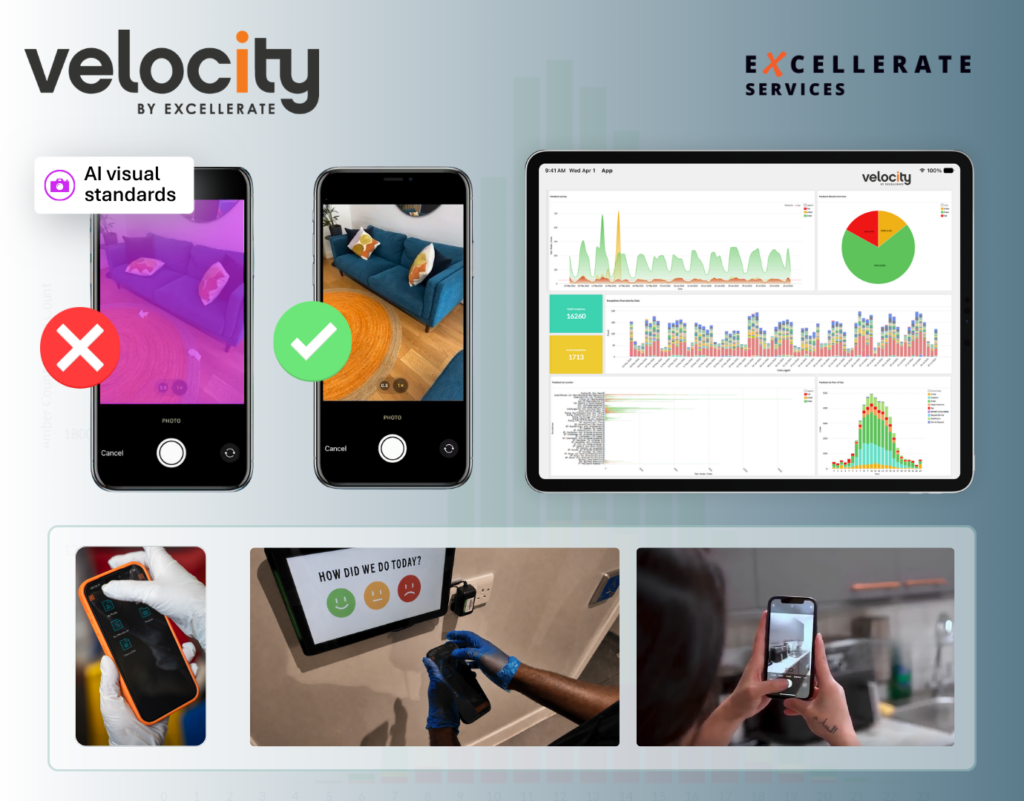
Usage data tells you when to clean. Sentiment tells you whether it worked. Some would argue sentiment is the only data point that matters where cleaning is concerned, since it reflects whether the environment meets the standard stakeholders expect. Built into the operating model, sentiment shifts cleaning away from a reactive, use-triggered response and towards consistently meeting the standard expected.
Where AI Adds Proactive Support
In a busy environment, cleaning once a day, or less, will not keep pace. Sentiment confirms standards after the fact, but it is still a reactive signal.
This is where AI adds value: proactive, objective support that works ahead of the next occupancy trigger or sentiment score.
Building a 'What Good Looks Like' Standard
Using a bespoke, site-specific “what good looks like” standard alongside image capture, teams get immediate feedback on whether a clean meets the required standard, without waiting for the next trigger point.
Over time, this builds a reference library of “good” that can be measured against daily usage and sentiment data, giving a much clearer picture of how a site’s specific usage patterns and culture affect cleanliness standards.
Shared Visibility, Shared Improvement
When clients and cleaning teams see the same data, on both usage and service output, everyone understands exactly how the service is performing. That shared visibility is what makes continuous improvement possible, rather than aspirational. A clear, well-designed dashboard gives both the contractor and the client’s management team full visibility of the rationale behind service delivery.
Cost is often assumed to be a barrier to this kind of system. In reality, options range widely, and some of the most capable, well-integrated systems are also the most accessible.
Velocity – our award-winning proprietary management information system – is one of them.